
The Hope Network
Choosing brave conversations for complicated times
Intergenerational. For 18+ year olds across Canada.
The Hope Network is an intergenerational network and pan-Canadian community moderated by CCRL’s award-winning educators and researchers. It started in 2022 because young adults we spoke with were concerned about increasing levels of racial and religious discrimination and didn’t have a place to discuss this with others.
To help the youth and young adults address these social challenges, we created a network to develop religious literacy knowledge, skills, and attitudes so they can prevent, identify, and address discrimination and navigate the broad topic.
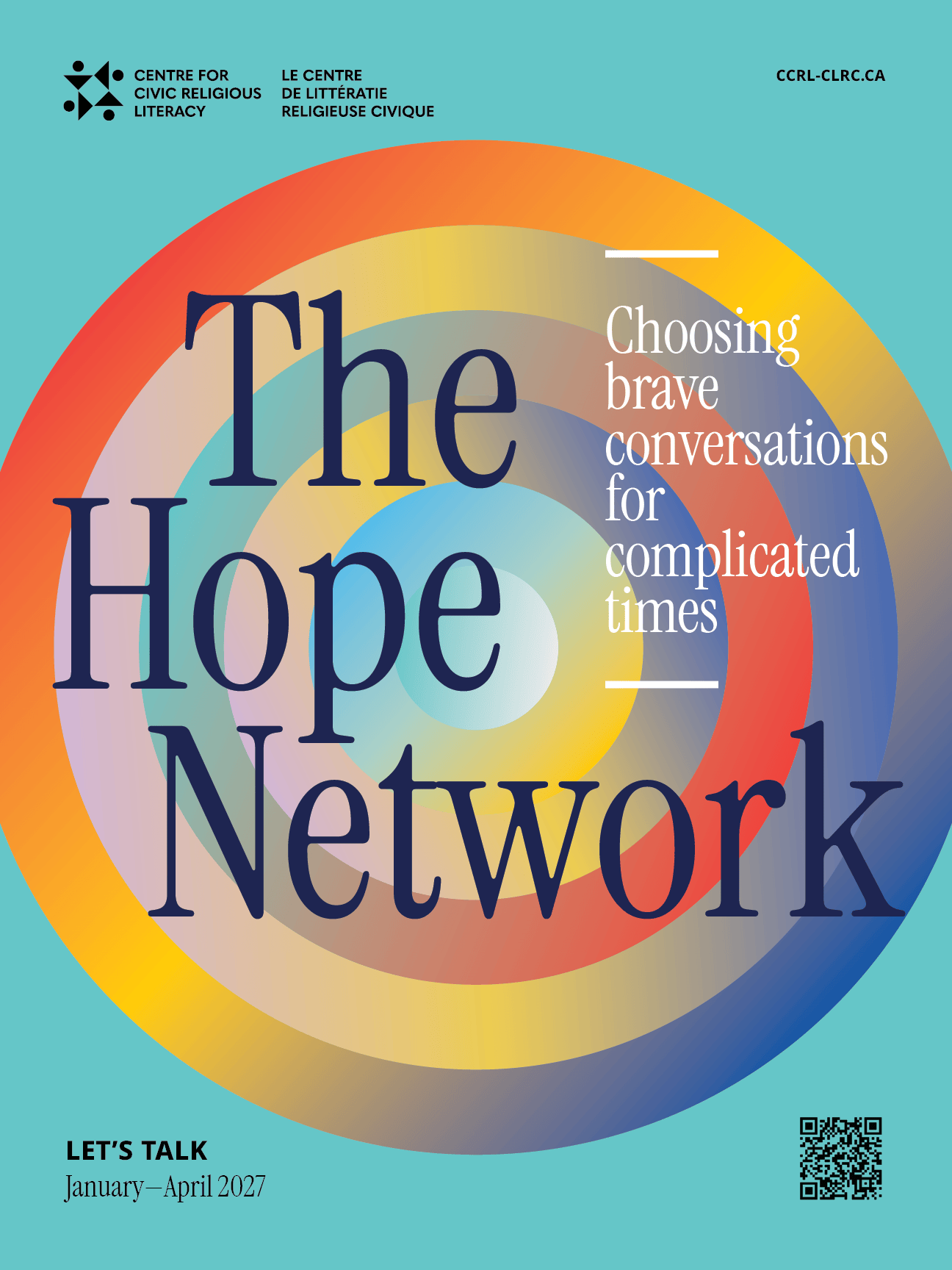
The Hope Network
January – April 2027
The Hope Network 2027 cohort welcomes young adults, adults, and older adults to discuss and address misinformation and disinformation.
The program will occur in 5 different cities. Each city will discuss the same 4 topics.
The 2 in-person discussions (session #1 and #4) will include local guest speakers. The 2 online discussions (session #2 and #3) are an opportunity for all Hope Network participants to join the discussion at the same time, regardless of location.
The online sessions will have guest speakers who can provide a national and international scope. Meeting online as a full Network will offer an opportunity to connect participants across the five cities to promote cross-provincial interaction – a way to encourage stronger understanding and relationship building across Canada.
See below for details by location.
Sessions and topics:
Four interactive sessions will explore how misinformation and disinformation influences us and society today.
- Nationalism: Why are convictions so polarizing today? Discussing separatism, religious/secular nationalism, and White Supremacy in Canada.
- Religious discrimination: Where does fear, contempt, and discrimination start and end? Reviewing how this affects all of us.
- Anti-Indigenous racism: Do we share a history? Looking into Residential Schools Denialism.
- Identity & belonging: How is our self-understanding influencing our relations (or not)? The manosphere, TradWives, identity, and belonging.
Click on your city below to find specific details by location:
- Hope Network in Edmonton, AB
- Hope Network in Regina, SK
- Hope Network in Toronto, ON (Details coming soon)
- Hope Network in Montreal, QC
- Hope Network in Sackville, NB
Join us in your city.
**Register here: https://tally.so/r/81v0BY
No previous knowledge or experience is required. Just bring your curiosity and willingness to listen.
Each session includes:
- Discussions and activities that are grounded in religious literacy
- Conversations hosted by CCRL’s award-winning educators and researchers
- Canadian guest speakers who share local insights related to each topic
- Intergenerational co-learning opportunities
Early bird Registration fees (before Dec 1)
- Young adults (18-24): $25
- Adults (25-64): $50
- Older adults (65+): $30
Fees are paid after the registration form has been completed and registration is confirmed by email.
**Register here: https://tally.so/r/81v0BY
Come meet people who are as curious as you.
What is civic religious literacy?
Religious literacy is not reading and writing about religion. Like media literacy, digital literacy, and financial literacy, religious literacy is about understanding how to navigate a broad topic.
It is an academic framework that includes knowledge, skills, and lenses to engage with religious, spiritual, and secular worldviews—topics that most Canadians shy away from or do not know how to discuss. CCRL introduces religious literacy in five specific principles described here in an intersectional way.
Today, misinformation and disinformation are creating social, political, and economic challenges for Canada and the world.
Canadian studies found that:
- In 2025, 47% of Canadians reported that it was becoming harder to distinguish between true and false news or information.
- In 2025, 80% of Canadians saw news or information on the Internet that they suspected to be misleading, false or inaccurate at least monthly.
- Older adults (55+) were more likely to believe false information and were less confident in their ability to identify false content compared to younger participants
(Foran & Bilodeau, 2026; Media Smarts, 2025)
These challenges impact social well-being as different mis- and disinformation narratives are embedded with religious, spiritual, and secular perspectives, symbols, and references, which can distort our understanding of one another to create uncertainty, fear, discrimination, and hate.
As AI evolves, we also need more skills to prevent or address unforeseen messages and challenges.
Our programming will tackle these tough topics through our five religious literacy principles and help participants respond and/or address these matters in an informed way. Religious literacy offers a set of principles that can guide us today and in the future.
Why join the Hope Network?

Statistics Canada, Census of Population, 2021.
The religious, spiritual, and secular demographic in Canada is varied and continues to shift each year. Individuals with a religious affiliation comprise 65% of the population but “most Canadians [score] higher on indicators of personal spiritual beliefs than they do on group or individual religious activities.” At the same time, a recent study found that Anglo-Canadian Millennials who self-identify as “spiritual but not religious,” perceive religion to be American, anti-modern, colonial, and conservative.
These nuances and variations in perspective, along with a large and growing population who hold secular perspectives and no religion means that we need the skills to understand the changing face of Canada.
Specifically, the Hope Network will help you:
- Understand different worldviews: Understand how religion, spiritual, and secular worldviews intersect with political and social issues and affect communities
- Challenge racism and discrimination: Learn or enhance practical skills to address racism and discrimination
- Build confidence in conversation: Become more comfortable and confident to engage in discussions about these subjects
- Build connections: Be part of a network of people locally and across the country who can support you in religious literacy learning and/or initiatives
- Question misinformation and disinformation: Learn how religious literacy can help counter misinformation and disinformation
- Put learning into action: Gain opportunities to participate in community engagement and involvement.
These skills are relevant in your place of work, study, the different communities you are part of and your personal lives.
Why do these conversations matter?
Not every we see, hear, or share is accurate. Misinformation and disinformation can influence how we understand events, communities, and one another.
They can also misrepresent religious, spiritual, and secular beliefs, creating fear, stereotypes, and discrimination.
Who can join?
The program is open to anyone who is 18+ years old residing in Canada.
We welcome individuals from urban, suburban, and rural regions across Canada who are from different backgrounds (including Indigenous, agnostic, atheist, Buddhist, Christian, humanist, Jewish, Muslim, and Sikh, among other religious, spiritual, and secular affiliations).
**Register here: https://tally.so/r/81v0BY
“Religious literacy changed me… it changed my thinking… it changed my attitude about myself and others.” – Karol Gabriela Bernal Saenz, past participant, cohort 2022-2023. To read more about Karol’s experience, click here.
“Now that I have attended these sessions, I will try to go on and understand different points of view but also the different justifications that motivate them.” – Past participant, cohort 2026
What we ask of participants:
You don’t need any prior experience or knowledge to be part of the Hope Network!
We only ask that you:
- Attend our meetings for their full duration
- Share your thoughts and experiences and listen to those of others
- Be open to reflecting on your own views and consider those of others
- Have a stable wifi connection for virtual sessions
At CCRL, our research and work have shown us that religious literacy is a practical framework that can positively transform minds and lives, and it can start with you.
Help us spread the word about the Hope Network.
Share using the different social media platforms at the bottom of this page.
Questions? Contact info@ccrl-clrc.ca.
The Hope Network is grounded in CCRL’s civic religious literacy principles and creates opportunities for people from diverse religious, spiritual, and secular backgrounds to learn together.
The Hope Network is based on a pilot project that was funded by Canadian Heritage. The Winter 2027 program is the fourth cohort of the program and changes have been made based on program evaluation funded by Canadian Network for Research on Security, Extremism and Society (CANSES).